LLBHUB
Ctrl K
Sign In
Feature Tour

Stop Reading 500 Pages.
Study What Actually Comes In Exams.

PYQs. Landmark Cases. Tables. Revision Sheets.
Everything already organized inside every note.

⭐⭐⭐⭐⭐ Trusted by CCSU Students  ·  ₹49  ·  Lifetime Access
📋
PYQs Inside Every Chapter
Past questions sorted chapter-by-chapter. No more searching 10 different papers.
⚖️
40+ Landmark Cases
Case name, facts, held — formatted exactly as examiners expect.
📊
Comparison Tables
Common Intention vs Common Object. Already prepared, exam-ready.
ALSO INSIDE EVERY NOTE → Revision Sheets · Exam Tips · Formula Cards · Section Numbers

Inside Every Note

Open a note. Everything is already there.

CCSU · LLB 3-YEAR SEM-1 · K-1006 · 2026

BHARATIYA
NYAYA SANHITA
2023

General Principles → Inchoate Crimes → General Exceptions → Public Tranquility → Women & Child

Ch.1 General Principles Crime · Mens Rea · Actus Reus · Liability
Ch.2 Inchoate Crimes Abetment · Conspiracy · Attempt
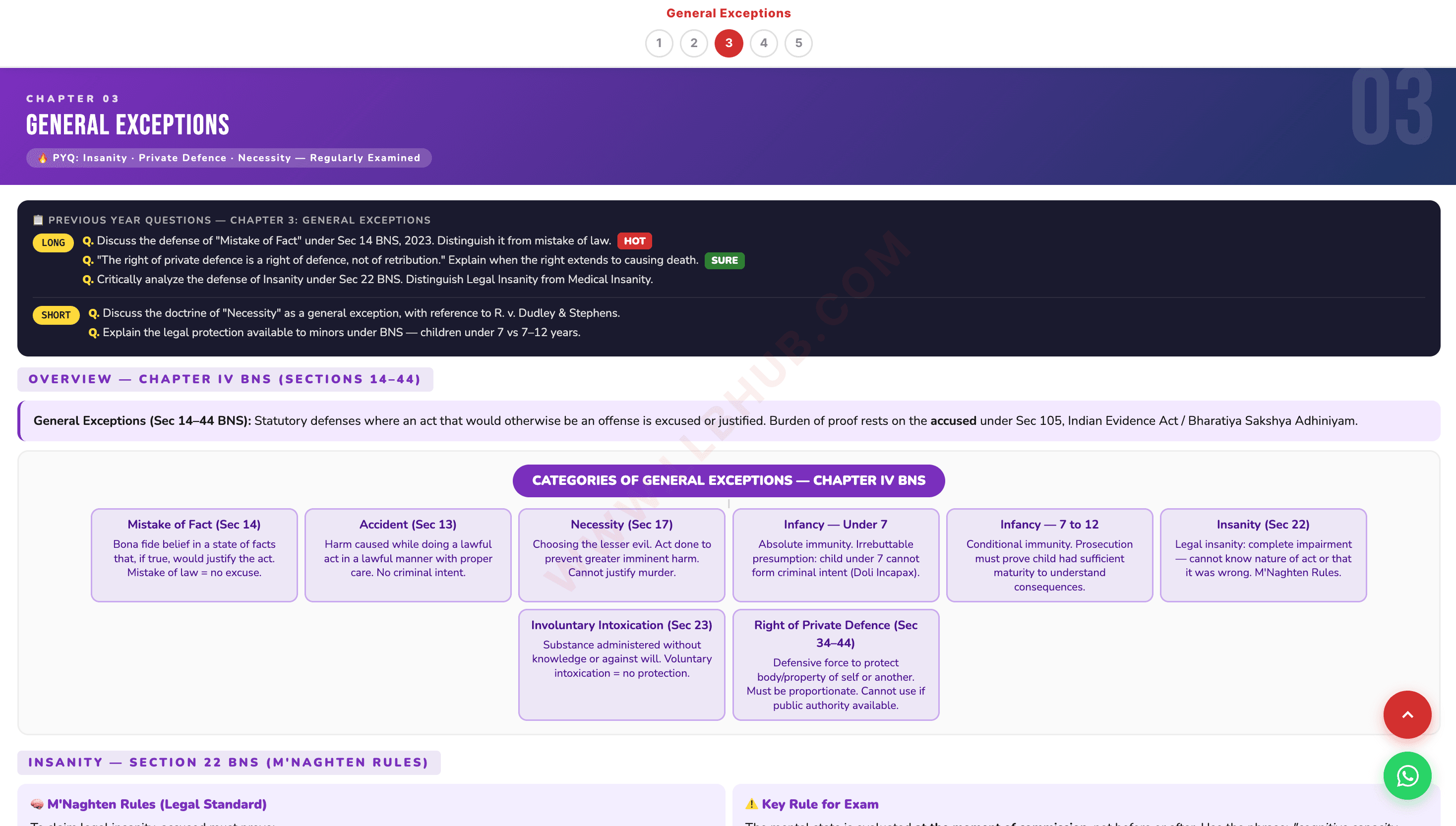
Ch.3 General Exceptions Insanity · Infancy · Private Defence
Ch.4 Public Tranquility & State Assembly · Rioting · Sedition
Ch.5 Women & Child Rape · Dowry · Kidnapping
📚 Appendix PYQ Digest · Tips · Cases
Chapter 01
GENERAL PRINCIPLES OF CRIME
🔥 PYQ: Elements · Mens Rea · Common Intention — Most Repeated
📋 Previous Year Questions — Chapter 1: General Principles
LONG
"Crime is a socio-legal phenomenon." Define crime and explain its essential elements with reference to BNS, 2023. HOT
Critically evaluate the maxim Actus non facit reum nisi mens sit rea. Are there exceptions? Discuss with case law.
Distinguish clearly between Common Intention (Sec 3(5)) and Common Object under BNS, 2023. Illustrate with landmark judgments. SURE
SHORT
Write a short note on corporate criminal liability and the element of "Human Being" under BNS.
Explain the four distinct stages in the commission of a crime. At what stage does criminal liability begin?
Definition & Nature of Crime
Crime (BNS 2023): An unlawful act or omission prohibited by public law, injurious to public welfare, and punishable by the State in formal legal proceedings. Section 2 of BNS establishes foundational definitions; Section 3 lays down structural categories of liability and punishment.
⚖️ Crime (Public Wrong)
Breach of public rights affecting entire community. Prosecuted by the State for punishment. Remedy = punishment/fine/imprisonment.
📄 Civil Wrong (Private Wrong)
Infringement of private rights of an individual. Prosecuted by the injured party for compensation or restitution. Remedy = damages/injunction.
4 ESSENTIAL ELEMENTS OF CRIME
👤 Human Being
Must be a natural or legal person under a legal obligation & capable of being punished. Corporations liable for fines.
🧠 Mens Rea
Guilty mind — intention, knowledge, recklessness, or negligence at time of act. "No crime without a guilty mind."
🤜 Actus Reus
Prohibited physical act or illegal omission. Must be voluntary. Both act + consequence covered.
🩹 Injury
Illegal harm to body, mind, reputation, or property. Completes the offense (hurt, defamation, mischief).
Stages of Crime
CHRONOLOGICAL STAGES OF A CRIME
💭 Mental Intention
Formation of criminal idea. Non-punishable — impossible to read minds. No external act yet.
🔧 Preparation
Arranging means/instruments. Generally non-punishable. Exception: waging war, counterfeiting.
🎯 Attempt
Direct overt movement toward offense — falls short due to external factors. Punishable under Sec 62 BNS.
✅ Commission
Successful completion of offense. Full statutory liability under relevant BNS section.
Intention
Mental stage only. Law cannot punish thoughts.
Preparation
Arranging means. Still retractable. Not punishable generally.
Attempt
Crosses locus poenitentiae. Punishable. External factors foil completion.
Commission
Crime fully executed. Maximum punishment applies.
Forms of Criminal Liability
CLASSIFICATIONS OF CRIMINAL LIABILITY
Individual Liability
Single actor has both mens rea and actus reus. Standard criminal liability.
Common Intention (Sec 3(5))
Pre-arranged plan. All participants equally liable for acts done in furtherance. Needs prior concert.
Common Object (Sec 190)
5+ persons in unlawful assembly. Spontaneous object, no prior plan needed. Membership = liability.
Strict Liability
Mens rea completely excluded by statute. Mere prohibited act = guilt. Public safety offenses.
Vicarious Liability
Master liable for agent's statutory infractions. Rare in criminal law. Corporate/employer scenarios.
⚡ Strict Liability Rule: Where statute clearly excludes mens rea (public health, economic offenses), the mere performance of the prohibited actus reus establishes guilt — regardless of innocent intent. See: State of Maharashtra v. Mayer Hans George (1965).
Common Intention vs Common Object
BasisCommon Intention — Sec 3(5) BNSCommon Object — Sec 190 BNS
Statutory ProvisionSection 3(5) of BNS, 2023Section 190 (read with Sec 189) BNS
Prior ConcertRequires pre-arranged plan & prior meeting of mindsNo pre-arrangement needed; object can form spontaneously
Min. PersonsTwo or more personsMinimum five or more persons
ParticipationActive physical presence/overt supporting act neededMere membership in assembly at time of offense suffices
NatureRule of evidence & constructive liability; not a standalone offenseCreates a specific, substantive joint liability offense
Scope of ObjectIntention can be of any type/scopeObject must fall within specific categories under Sec 189
Landmark Cases
Fowler v. Padget (1798) 7 TR 509 — Court of King's Bench (UK)
Facts: Bankrupt left home for business; prosecuted under bankruptcy laws for departing the realm. Held: Bankruptcy cannot be established without intent to defraud. Affirmed: actus non facit reum nisi mens sit rea — the act alone does not make a man guilty.
Sherras v. De Rutzen [1895] 1 QB 918 — Queen's Bench Division (UK)
Facts: Publican served alcohol to off-duty officer not wearing badge; convicted under strict reading. Held: Conviction quashed. Presumption that mens rea is essential in every offense — displaced only if statute clearly excludes it.
Mahbub Shah v. Emperor (1945) — Privy Council
Facts: Relatives fired shots; alleged joint liability. Held: "Similar intention" ≠ "Common intention." Sec 3(5) BNS requires pre-arranged plan + prior meeting of minds + active participation.
Barendra Kumar Ghosh v. Emperor (1925) — Privy Council (Sankari Tola Post Office Case)
Facts: Group robbed post office; appellant stood outside as lookout & didn't fire. Held: Conviction upheld. "They also serve who only stand and wait." Physical presence as lookout = equal liability under common intention.
State of Maharashtra v. Mayer Hans George (1965) AIR 722 — Supreme Court of India
Facts: German smuggler transporting gold stopped in Bombay mid-flight; prosecuted under FERA despite no knowledge of law change. Held: Statutory public safety/economic regulations can exclude mens rea — strict liability applies to safeguard national interests.
Latin Maxims
Actus non facit reum nisi mens sit rea — Act doesn't make guilty unless mind is also guilty
Actus me invito factus non est meus actus — Act done against my will is not my act
Versari in re illicita — Engaged in unlawful activity = liable for all consequences
Cogitationis poenam nemo patitur — No one suffers punishment for thoughts alone
Chapter 02
INCHOATE CRIMES / PRELIMINARY OFFENCES
🔥 PYQ: Abetment · Conspiracy · Attempt vs Preparation — Frequently Asked
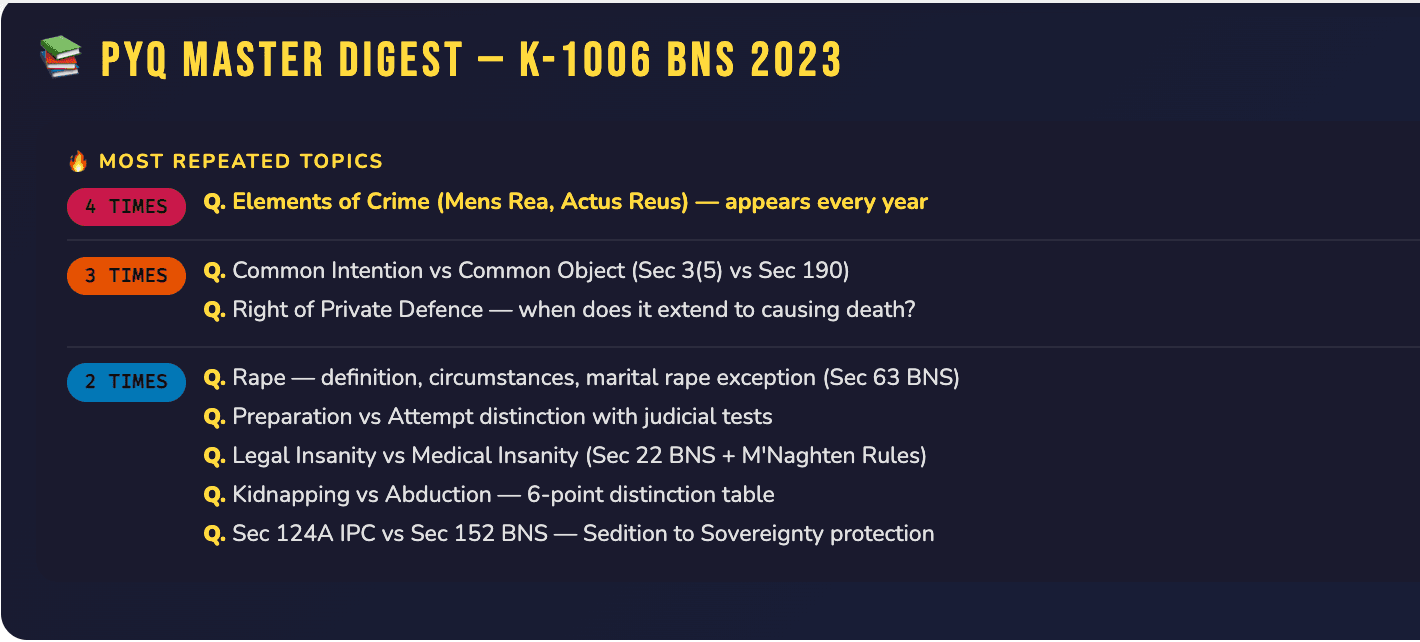
📚 PYQ MASTER DIGEST — K-1006 BNS 2023
🔥 MOST REPEATED TOPICS
4 TIMES
Elements of Crime (Mens Rea, Actus Reus) — appears every year
3 TIMES
Common Intention vs Common Object (Sec 3(5) vs Sec 190)
Right of Private Defence — when does it extend to causing death?
2 TIMES
Rape — definition, circumstances, marital rape exception (Sec 63 BNS)
Preparation vs Attempt distinction with judicial tests
Legal Insanity vs Medical Insanity (Sec 22 BNS + M'Naghten Rules)
Kidnapping vs Abduction — 6-point distinction table
Sec 124A IPC vs Sec 152 BNS — Sedition to Sovereignty protection
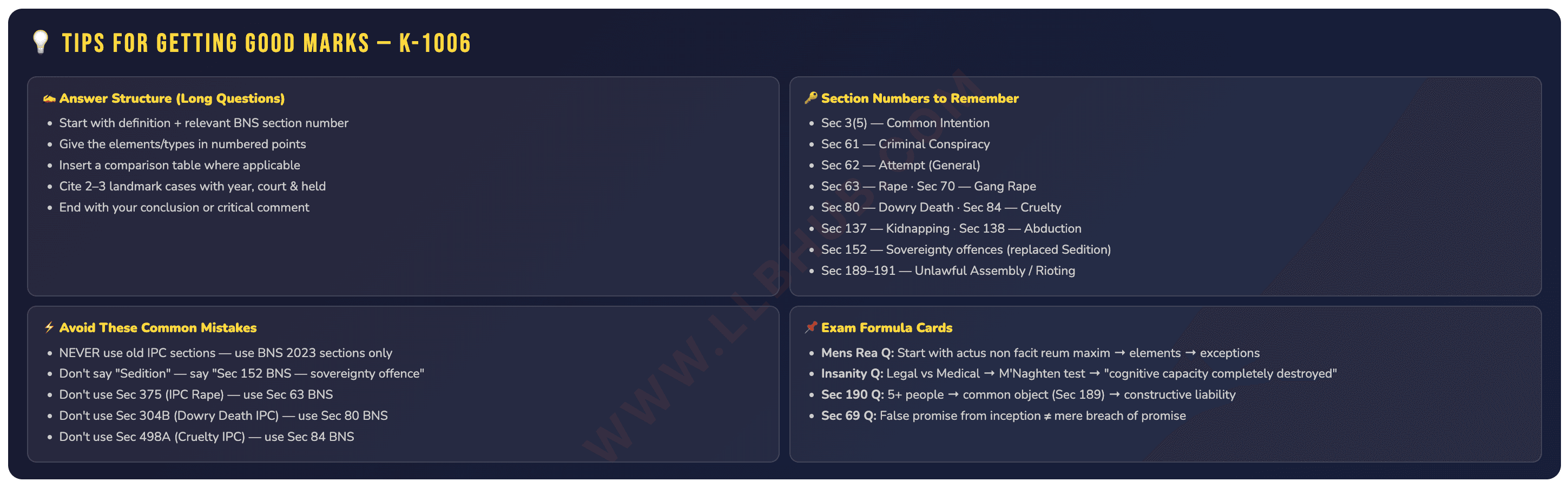
💡 TIPS FOR GETTING GOOD MARKS — K-1006
✍️ Answer Structure (Long Questions)
  • Start with definition + relevant BNS section number
  • Give the elements/types in numbered points
  • Insert a comparison table where applicable
  • Cite 2–3 landmark cases with year, court & held
  • End with your conclusion or critical comment
🔑 Section Numbers to Remember
  • Sec 3(5) — Common Intention
  • Sec 61 — Criminal Conspiracy
  • Sec 62 — Attempt (General)
  • Sec 63 — Rape · Sec 70 — Gang Rape
  • Sec 80 — Dowry Death · Sec 84 — Cruelty
  • Sec 137 — Kidnapping · Sec 138 — Abduction
  • Sec 152 — Sovereignty offences (replaced Sedition)
  • Sec 189–191 — Unlawful Assembly / Rioting
⚡ Avoid These Common Mistakes
  • NEVER use old IPC sections — use BNS 2023 sections only
  • Don't say "Sedition" — say "Sec 152 BNS — sovereignty offence"
  • Don't use Sec 375 (IPC Rape) — use Sec 63 BNS
  • Don't use Sec 304B (Dowry Death IPC) — use Sec 80 BNS
  • Don't use Sec 498A (Cruelty IPC) — use Sec 84 BNS
📌 Exam Formula Cards
  • Mens Rea Q: Start with actus non facit reum maxim → elements → exceptions
  • Insanity Q: Legal vs Medical → M'Naghten test → "cognitive capacity completely destroyed"
  • Sec 190 Q: 5+ people → common object (Sec 189) → constructive liability
  • Sec 69 Q: False promise from inception ≠ mere breach of promise
⚖️ QUICK CASE DIGEST — ALL 5 CHAPTERS
Case NameYearRule / Principle (One Line)
Fowler v. Padget1798Established actus non facit reum — no crime without guilty mind
Sherras v. De Rutzen1895Presumption that mens rea is essential in every offense
Mahbub Shah v. Emperor1945Similar intention ≠ Common intention; prior meeting of minds required
Barendra Kumar Ghosh v. Emperor1925"They also serve who only stand and wait" — lookout equally liable
Mayer Hans George1965Economic/public safety statutes can exclude mens rea — strict liability
Queen-Empress v. Ramakka1884Running toward well = preparation only; locus poenitentiae still available
Scroll inside to explore
50+
PYQs Analyzed
40+
Landmark Cases
20+
Comparison Tables
₹49
Lifetime Access

The difference is night and day

Without LLBHUB
Read entire 500-page textbooks
Search PYQs from 10 different papers
Find landmark cases one by one
Make your own revision notes
Guess what topics to study
With LLBHUB
PYQs embedded inside every chapter
40+ landmark cases already extracted
Comparison tables exam-ready
Revision sheets already prepared
Exam pattern already analyzed for you

Everything built inside. Nothing to find yourself.

Every feature below is live in every note you buy.
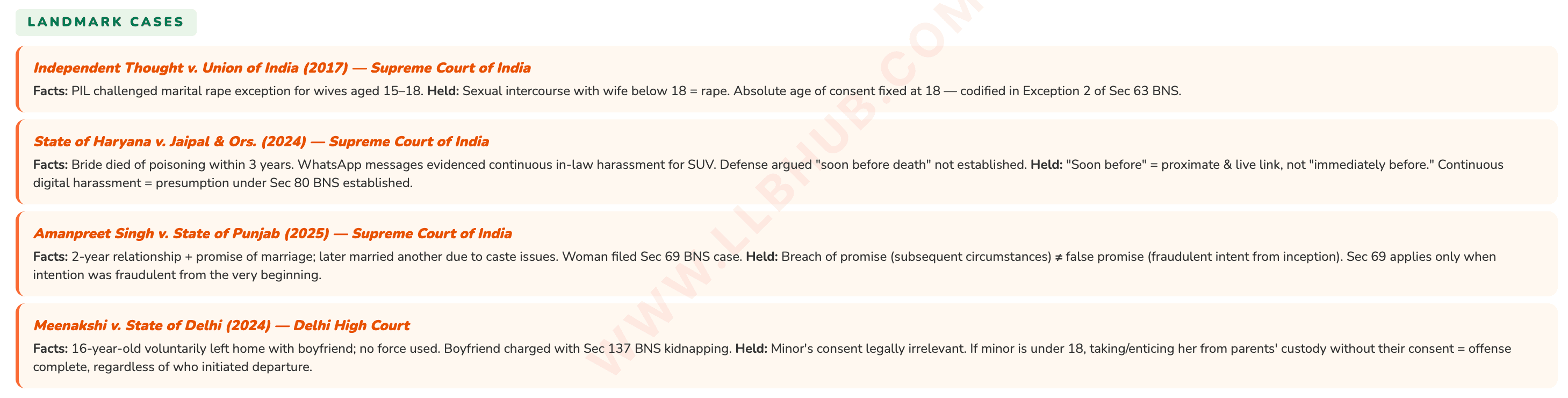
Landmark Cases Ready to Cite
Case name, facts, held — formatted exactly as examiners want.
Sticky Chapter Navigation
Numbered circles lock to top as you scroll. Jump to any chapter in one tap.
Comparison Tables
Comparison Tables
Common Intention vs Common Object — exam favourites, already prepared.
Exam Tips & Formula Cards
Section numbers, legal maxims, common mistakes. All in one place.
PYQ Master Digest
PYQ Master Digest
Topics that appeared 4×, 3×, 2× in past exams. Stop guessing.

Try it yourself →

Click any chapter circle

This is exactly how the sticky navigation works inside every LLBHUB note. You're always one tap away from any chapter.

Jumped to: Ch.3General Exceptions

Works on Every Device

Study Anywhere.

Library
Hostel
Bus
Classroom
Exam Hall Revision

No download. No app. Works beautifully on every screen.
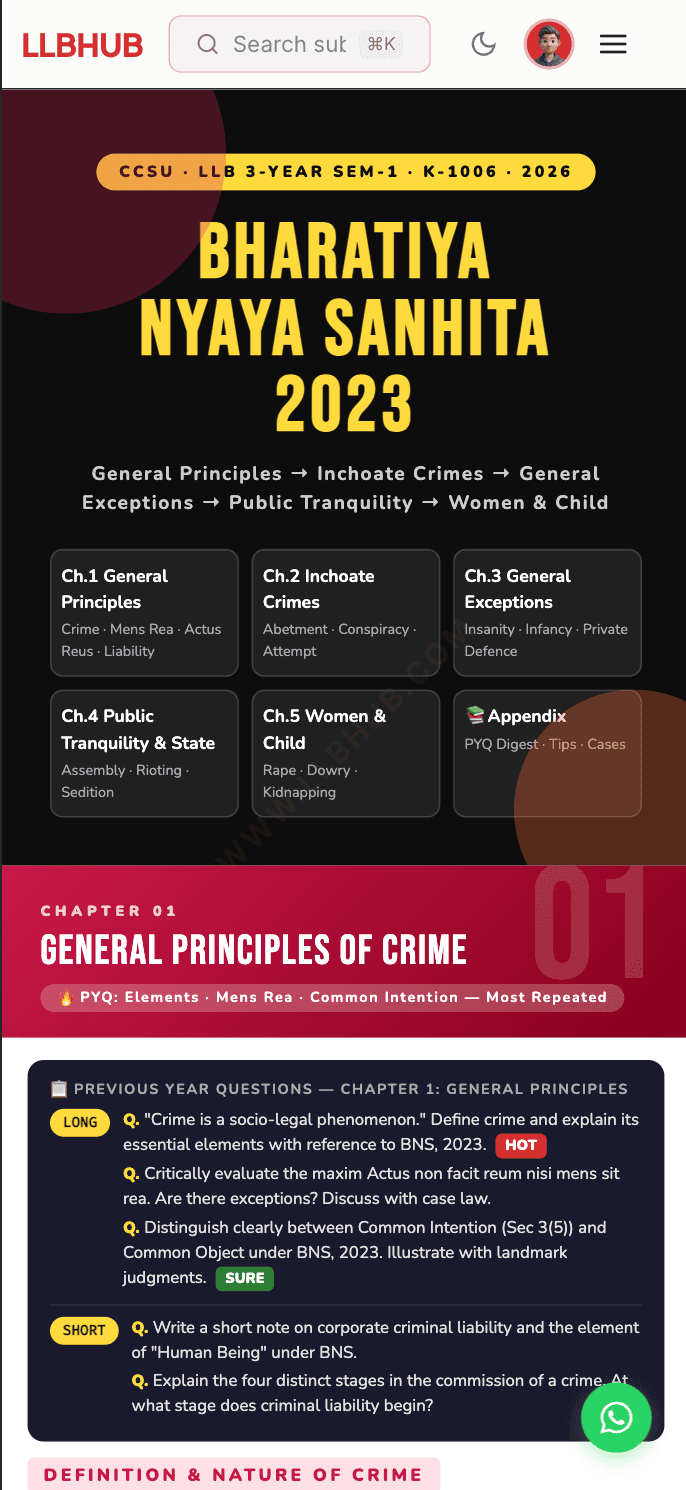
LLBHUB on mobile
500+
Pages Condensed
50+
Landmark Cases
100+
PYQs Analyzed
20+
Comparison Tables

What students say

★★★★★

PYQ digest alone saved me hours of searching. I knew exactly what to prepare.

CCSU LLB Student
Semester 2
★★★★★

Cases already extracted, tables already made. Best ₹49 I have spent before exams.

CCSU LLB Student
Semester 3
★★★★★

I revised the entire subject in one evening. Never happened before with a textbook.

CCSU LLB Student
Final Year

Your classmates will still read books.

You'll revise from exam-ready notes. ₹49. Lifetime access.

Most Popular
₹49
One Subject · Lifetime Access
Less than a coffee ☕
Chapter Notes + PYQs
40+ Landmark Cases
Comparison Tables
Exam Tips & Formula Cards
Works on all devices
Start Reading Now →

No subscription · Instant access